 Scroll to explore
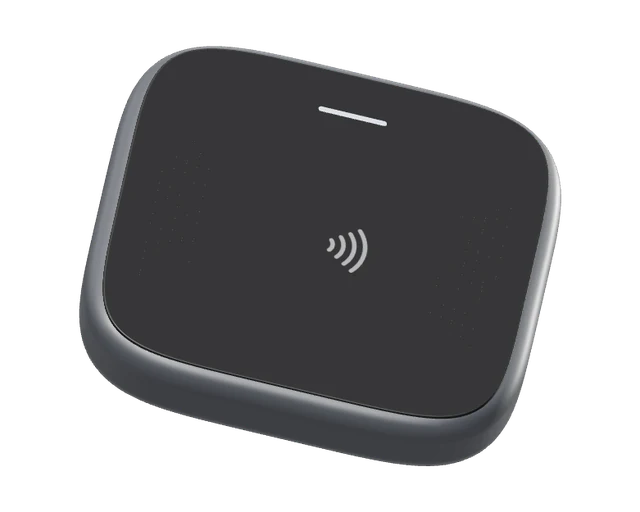
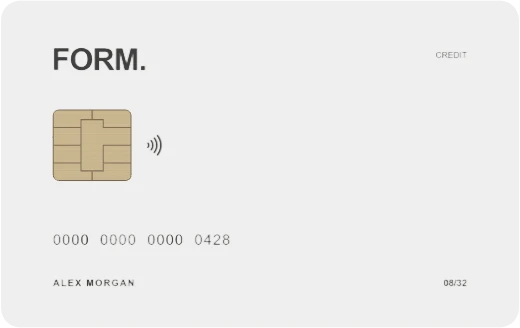
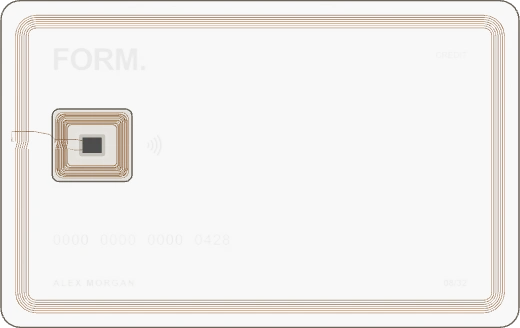
Inside the key, the card and the phone: a copper coil and a chip.
Those are the things you use every day.
and almost nobody knows how it works
RFID spells Radio-Frequency Identification.
It swaps data without touching.
That’s literally it.
The card has no battery. So how does it talk?
Drag the card to the reader
Check byte C0
The reader’s field powers the card. The card uses that power to answer. The reader reads the answer.
No battery. No contact. All in about five thousandths of a second.
The card never broadcasts. It answers by taking more or less of the reader’s field, and the reader feels the change.
Inside the key, the card and the phone: a copper coil and a chip.
Take it apart
Here it is, slowed down and taken apart. Engineers call the card a tag. Every number below is calculated as you change things.
6
The field fades very fast with distance. A bigger coil catches more of it, which is why the card’s coil runs around its whole edge.
Real name: inductive coupling. A card must work in a field from 1.5 to 7.5 A/m (ISO/IEC 14443-2).
7
Only a changing field makes electricity. The reader’s field flips 13.56 million times a second.
Real name: Faraday’s law of induction. The voltage is the speed of the change: V = ω · M · I.
8
The coil and the tiny capacitor beside it swing together, like a child on a swing pushed at just the right moment. Tuned right, a weak field is enough.
Real name: resonance, f = 1 / (2π√LC). A card’s chip draws about 5 mW; a key’s about 75 µW, so the key leans on tuning far more.
9
Metal makes its own currents that push against the field, and it knocks the coil out of tune.
Real name: eddy currents and detuning. Modelled as a perfect conductor: a mirror image of the reader’s coil, with the current reversed.
10
The phone talks by switching its field off for an instant. A chip with no battery has to survive every pause, a few millionths of a second long, on saved energy.
Real name: 100% ASK pauses, modified Miller coding. Each pause lasts about 2.4 µs.
11
The chip never sends anything. It changes how much of the field it soaks up, and the reader feels the difference in its own coil.
Real name: load modulation.
12
The card’s answer is tiny next to the reader’s own field. So the chip flickers its dips 847,500 times a second. That moves its answer to a pitch the reader can pick out.
Real name: the subcarrier, 13.56 MHz ÷ 16 = 847.5 kHz.
13
With “dip for 1, quiet for 0”, a run of zeros is a flat line, and a reader whose clock runs a little fast loses count. With “every bit changes in its middle”, the count never slips.
Real name: Manchester coding.
14
A dip drowns and a 1 becomes a 0. A check bit on every byte and a check number on every message catch it, and the phone asks again.
Real name: odd parity bits and CRC_A (ISO/IEC 14443-3). The card also checks its own ID when the phone selects it.
15
You’re not supposed to see this… But just this once, we’ll make an exception.
Every tap starts with the same six messages. The phone works out every bit from the dips alone: it never peeks at the card’s memory.
Real name: ISO/IEC 14443-3: REQA, ATQA, anticollision, UID, SELECT, SAK.
16
Both cards answer at once. Where their IDs differ, the reader hears a 1 and a 0 together: a clash. It picks one side, and the other card goes quiet. That’s why tapping a whole wallet can charge the wrong card.
Real name: bit-wise anticollision (ISO/IEC 14443-3). Transport for London calls it “card clash”.
17
A reader and a tag have to be tuned to each other. The key is tuned to 125 kHz; the phone’s field flips at 13.56 MHz, about 100 times faster.
Real name: low frequency (LF, 125 kHz) and high frequency (HF, 13.56 MHz).